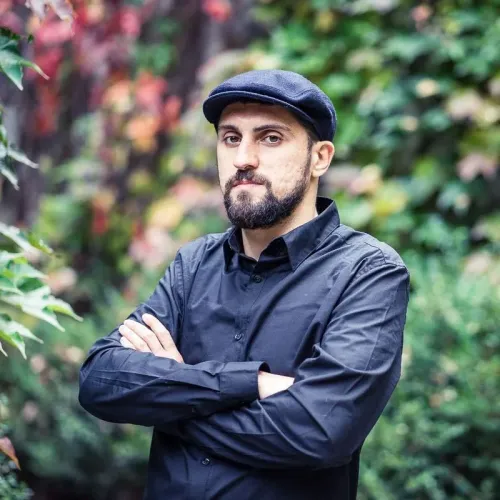
Amir Taaki
"Anarchist Amir" - Bitcoin pioneer, Dark Wallet creator, and Ethereum influence

Amir Taaki is a Bitcoin pioneer, privacy technologist, and anarchist developer who was known in early Ethereum circles as "Anarchist Amir" (to distinguish from "Capitalist Amir"). While he never joined the Ethereum project, he played a significant role in its genesis through his friendship with Mihai Alisie and Vitalik Buterin, and the ideas developed in his hack labs directly influenced Ethereum's conception.
Background: Free Software and Poker
Before Bitcoin, Amir worked on free software for five or six years, then became a professional poker player for over two years. It was the poker world that led him to cryptocurrency - he was frustrated with the high fees poker sites charged:
"The sites charge a huge amount of fees for a really crappy service. So I had this idea, what if you could have a P2P site, then it wouldn't have rake and fees."
While searching for a decentralized payment solution in the summer of 2010, a friend shared ten random links to open source money projects. Amir was initially skeptical of Bitcoin:
"I saw Bitcoin, I opened the page for Bitcoin, it goes Bitcoin is a P2P currency that cannot be controlled by governments or central banks. And I was like, that's garbage, like obviously not."
But when he downloaded and printed out the source code (about 15,000 lines at the time), everything changed:
"I printed it all out and I covered it all over my floor. You know, it's like my pornography that I'm looking at. I started studying it. And it started to make sense… And so when I figured out how it worked, I was like, whoa, this is amazing. I'm going to work on this."
Early Bitcoin Development
Amir became one of the first five Bitcoin developers listed on bitcoin.org. He created Libbitcoin in 2011, an alternative Bitcoin implementation that remains active today under Eric Voskuil's leadership.
He also created the BIP (Bitcoin Improvement Proposal) system, motivated by concerns about Gavin Andresen's approach to Bitcoin development:
"He saw Bitcoin not as an open source project but as a startup… I was very worried because he wasn't treating it like an open source protocol… there needs to be some constraint on his wild ideas. So that's why I proposed that system."
Amir pioneered Bitcoin privacy technology, creating the first CoinJoin and Stealth implementations.
European Anarchist Hacker Movement
Amir was part of a network of anarchist hackers living in squatted buildings across Europe:
"There's all these squatter's laws, which if a building is like abandoned, you can move into the building… we'd get amazing buildings. So in Amsterdam, we had a huge house. Imagine we're working on free software. We're broke devs. It's a really useful lifeline to have."
In 2012, he reconnected with Mihai Alisie, his friend from years earlier:
"I just saw him randomly on the internet and I was like, bro, I'm making a conference. Come to my conference… He now looked like Jesus. But he had long hair and long beard and stuff."
After a Bitcoin conference, Mihai walked into a building that happened to be the headquarters of Occupy activists in London. Amir joined him there, and they spent about a year living together in the squat, setting up a hack lab.
Calafou and the Birth of Ethereum Ideas
The pair then moved to Calafou, an eco-industrial colony near Barcelona that was part of the CIC (Cooperativa Integral Catalana), a network of anarchist cooperatives in Catalonia. There, Vitalik Buterin came to live with them.
"So then it was, and then there was like two other Spanish hackers, which are old friends of mine. And we were working together on projects… So we were doing a whole bunch of stuff there in the hack lab."
The hack lab worked on cryptocurrency tools for the cooperative network, developing ideas that would later influence Ethereum. Their wiki documented concepts like BitLaw - transparency, arbitration, auditing, multisigs, and other "cryptocurrency 2.0" applications:
"So then that's when Vitalik started to become interested in those ideas."
Connection to Gavin Wood
Gavin Wood also visited the London squat, where he met "Johnny Bitcoin" (Jonathan James Harrison). Amir recalled being impressed by Gavin's credentials:
"I was impressed by it. I was like, whoa, he's got a KDE email."
Johnny would later introduce Gavin to Vitalik, leading to Gavin becoming Ethereum's co-founder and CTO.
Declining the Ethereum Role
When Ethereum was being formed, Amir was asked to be the lead developer. He declined:
"They did ask me to be the lead Ethereum dev… but I just didn't, I was like, we can build this on Bitcoin. Why do you need a new thing? Yeah, because I know you can build it on Bitcoin."
When pressed on use cases, the answer wasn't compelling:
"I kept pressing the guy to explain to me what it can be used for. And he just kind of in frustration just went, marriage contracts… I don't see the point."
Looking back, he acknowledges this was a missed opportunity:
"It's interesting because sometimes you can be too closed minded about things… I think what led to Ethereum's success was having a token. Having the token is really good because it allows the project to accrue value. Whereas working on Bitcoin, we were always broke."
Dark Wallet and Dark Market
Amir co-founded Dark Wallet with Cody Wilson (of 3D-printed gun fame) in 2013, focusing on Bitcoin privacy. The first Dark Wallet hackathon was held at Macao, a squatted cultural center in Milan, where many early Ethereum contributors met each other.
At the Bitcoin Expo Toronto hackathon in April 2014, Amir and his team built Dark Market, winning the $15,000 prize:
"We did the Dark Market just purely for money. Because, you know, $15K."
Dark Market later became OpenBazaar.
Syria and Beyond
In 2015, Amir traveled to Syria to fight with the YPG (Kurdish People's Protection Units) against ISIS. During his absence, Dark Wallet development "fizzled out":
"I thought the dev team would at least just finish it. They had enough money and everything… They kind of like, it just fizzled out without my presence. Which is like, it's a failing of my leadership not to create an organization that doesn't fizzle out when one person disappears."
Reflections on Ethereum
Despite not joining Ethereum, Amir sees it as the closest existing expression of the "Agora" - the anarchist ideal of a free marketplace. However, he has criticisms:
"I think Ethereum needs to develop a political philosophy. The one with Ethereum is it's very ahistorical… I think you have to go deep into things, take them apart… they want to change the world, do things of social benefit. That's why they're making now these Zuzalu kind of network state communities. Yeah, they're trying to recreate the Calafou thing, the Calafou experience."
On Ethereum's development approach:
"I also think Ethereum needs to be more product-focused… not like, Ethereum is like, it was made in a time when you can launch absolutely anything and it would succeed. And, you know, they did really well. But the thing is, people see what Ethereum did and they think that's gospel for how to start a new project in crypto."
DarkFi
Amir's current project is DarkFi, an L1 blockchain with anonymous smart contracts using zero-knowledge proofs:
"You can do everything with it, but anonymous. So, you know, you can buy and sell, you can make anonymous DAOs, do OTC, etc. That's what we need to build the Agora."
Other Media
Links
Primary Source
This profile draws from Amir Taaki's Early Days of Ethereum interview, recorded at Dark Prague in December 2025, which provides first-hand accounts of early Bitcoin development, the hack lab culture, and his connections to Ethereum's founders.
Back-links
Other pages that reference this:
- Ethereum Timeline (Legacy) (Articles)
- Taylor Gerring Photos (Articles, January 25, 2014)
- Bitcoin Expo 2014 (Articles, April 11, 2014)
- Early Days of Ethereum - Episode 8 - Michael Parenti (Videos, December 17, 2025)
- Early Days of Ethereum - Episode 9 - Amir Taaki (Videos, December 31, 2025)
- Amir Chetrit (People)
- Anthony Di Iorio (People)
- Cody Wilson (People)
- Gavin Andresen (People)
- Gavin Wood (People)
- Jonathan James Harrison (People)
- Mihai Alisie (People)
- Vitalik Buterin (People)